Leadership & Development


Competence Development
Professional engagements in competence development and knowledge sharing are fostered through long-term structured initiatives in team building, technical development, mentoring, internal training, and cross-organisational collaboration, contributing to strengthened organisational capability and professional performance

Development Projects
Development projects demonstrate a sustained contribution to advancing methods, systems, and competence within urban water engineering. The work reflects innovation and leadership in developing practical solutions that support strategic decision-making, operational improvement and organisational capability in modelling, planning and infrastructure management
Water is life!
2010–2013 | Capacity Building & Internal Development Structure (SCA / BIOFOS)
Team building/development & knowledge sharing
Established and led an internal technical development group focused on hydraulic modelling, programming and hydrological and hydraulic applications.
Introduced a structured framework for internal training, knowledge sharing, and project workshops to strengthen organisational competence, improve quality assurance and enhance collaboration with consultants and contractors.
Included supervision of BSc thesis projects.
2013–2015 | Method Development & Mentoring (SWECO)
Capacity development & knowledge sharing
Contributed to competence development through mentoring of junior colleagues and development of methodologies, working practices and standardised approaches for modelling and quality assurance.
Established and led the development project Guidlines for Modelling.
2017–2018 | Project-Based Capacity Development (MT HØJGAARD)
Capacity development & knowledge sharing
Supported and guided junior colleagues within the design organisation, strengthening technical competence in hydraulics, hydrology and modelling within project environments.
2018–2022 | Internal Training & Knowledge Sharing (WSP)
Capacity building & knowledge sharing
Initiated and delivered internal training programmes in MIKE URBAN, MIKE+, 1D/2D modelling and GIS.
Contributed to continuous coaching, mentoring, and strengthened knowledge sharing across projects and technical teams, including supervision of MSc thesis projects.
Included supervision of MSc thesis projects.
2022–2024 | Network Leadership & Collaboration (COWI)
Capacity development & knowledge network expansion
Initiated and led a national competence and collaboration network for hydraulic and hydrological modelling in Sweden.
The initiative developed into a cross-organisational platform connecting modellers, specialists, and project managers, strengthening collaboration, knowledge sharing, and technical development across the organisation.
2013–Present | Peer Reviewer for IWA Journals
Peer reviewer for the International Water Association (IWA) journals
Water Science & Technology, Water Practice & Technology and H2Open journal


Competence Development


2005–2010 | Urban Development Projects (Egedal)
Knowledge sharing, standard workflow and savings
Developed and implemented a structured process for governance and management of water, waste- and rainwater in urban development projects, from planning and master plan stages through investment, modelling, design, execution, delivery and handover to the utility.
The process strengthened quality assurance, improved project delivery efficiency and contributed to cost savings exceeding 17 million DKK, while enhancing long-term operation and sustainable management of water infrastructure.
2008–2010 | X-band Weather Radar (Egedal)
Procedure development and standard workflow
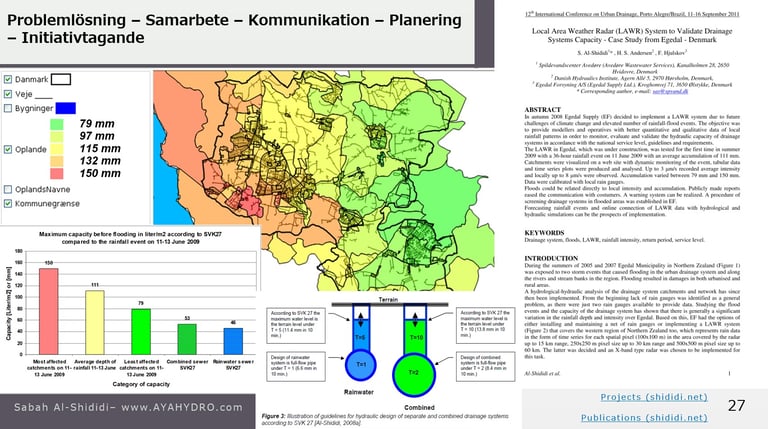
Initiated and led the development of a Rain Information System for real-time rainfall monitoring and forecasting using LAWR and X-band radar technology in collaboration with the Danish Hydraulic Institute (DHI).
The system strengthened flood preparedness and operational decision-making by providing improved rainfall data for modelling, analysis, and validation of drainage system capacity in accordance with national requirements and service levels.
See Paper.
2010–2010 | Modelling Handbook - (SCA / BIOFOS)
Team development and standard workflow
Established and led an internal technical group (the MOUSE group) focused on hydraulic modelling and applications producing the Modelling Handbook as a work standard.
Introduced a structured framework for competence development and knowledge sharing within the organisation, aimed at strengthening internal modelling skills together with client competence, improving quality assurance of external deliverables and clarifying requirements towards consultants and contractors.
2010–2012 | METSAM Project (Copenhagen)
Technical development
Participated as representative for SCA/BIOFOS in a full-scale real-time control demonstration project in Copenhagen’s two largest urban drainage catchments.
The project implemented and tested a system-wide control strategy based on radar-based forecasts and dynamic risk assessment to optimise sewer system performance, reduce combined sewer overflows and improve receiving water quality.
See Paper.
2012–2013 | 1D–1D Model Development (SCA / BIOFOS)
Technical development and workflow improvemnet
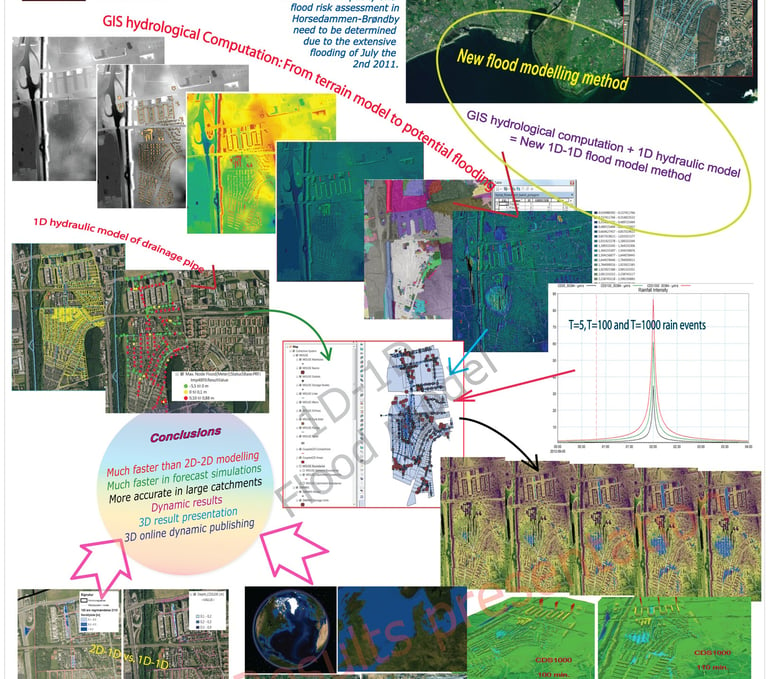
Conducted a flood risk assessment of the Horsedammen area in Copenhagen based on 5-, 100-, and 1,000-year rainfall scenarios.
Developed and applied a 1D–1D modelling approach combining high computational accuracy with significantly reduced simulation time compared to conventional 1D–2D methods, with strong potential for integration into operational decision support and radar-based forecasting systems.
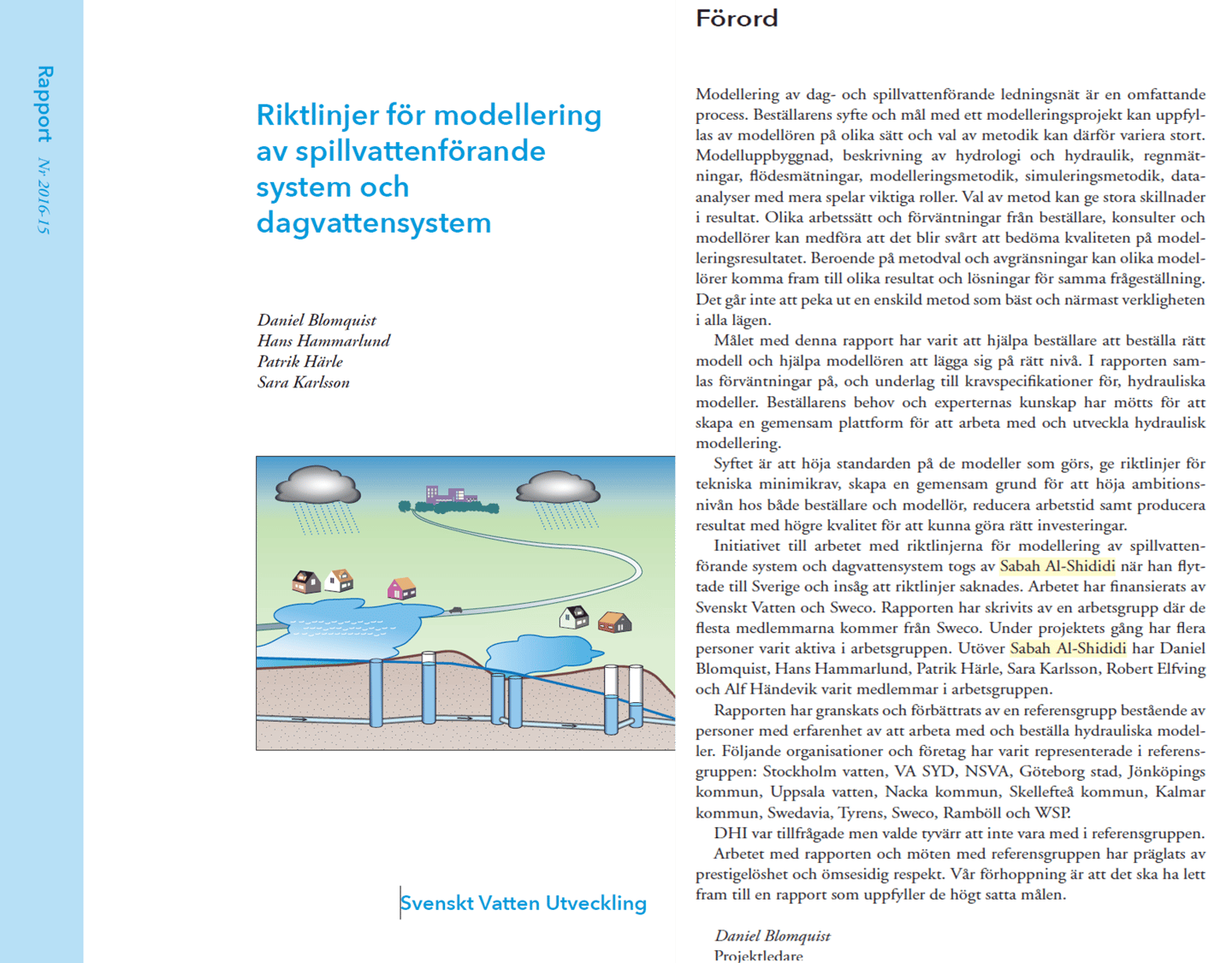
2014–2016 | Guidelines for Modelling (Svenskt Vatten)
Riktlinjer för modellering av spill- och dagvattensystem
Knwoledge sharing and workflow improvemnet
Led the development of national guidelines for hydraulic modelling of wastewater and stormwater systems (Report 2016-15).
The project established a common national framework for the development, application, and interpretation of hydraulic models to support investment planning, capacity assessment, climate adaptation and sustainable water infrastructure management.
See report Svenskt Vatten – Publikation.
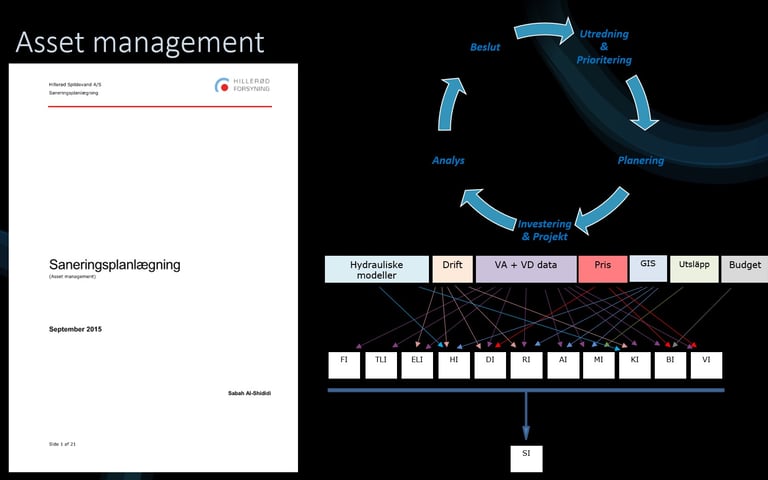
2015–2017 | Asset Management (Hillerød Forsyning)
Rehabilitation Planning - Procedure development
Developed an Asset Management methodology and urban water rehabilitation planning framework based on a multi-criteria Rehabilitation Index system.
The methodology integrates technical, operational, environmental, risk, and economic parameters to enable objective prioritisation of renewal measures and supports GIS-based analysis and strategic decision-making for long-term infrastructure management.
See Report.
2024–Present | AI Support in Modelling (AYA HYDRO)
Technical development and workflow improvemnet
Driving the development and application of AI-based methods to strengthen hydraulic modelling and workflows in urban water engineering.
The work focuses on integrating machine learning, automation, and data-driven approaches to improve efficiency, quality, and decision support, contributing to the digital transformation and modernisation of modelling and analysis processes.